RDF Foreign Data Wrapper
rdf_fdw is a PostgreSQL extension that creates virtual database tables inside a PostgreSQL database. The tables are based on SPARQL queries to an RDF store. The queries are converted on the fly, and the results are fetched from the store and converted to a response to an SQL query on the tables in real time. This process is executed without any intermediate storage.
There is support for push-down, meaning that some parts of the SQL query are pushed down into the resulting SPARQL query. Typical examples include sorting and filtering.
The installation guide on GitHub is quite clear, and you should be able to get the extension into your PostgreSQL database easily. I’ve used it to access the SWAPI ontology1 I installed in my local Fuseki RDF store.
The SWAPI store:
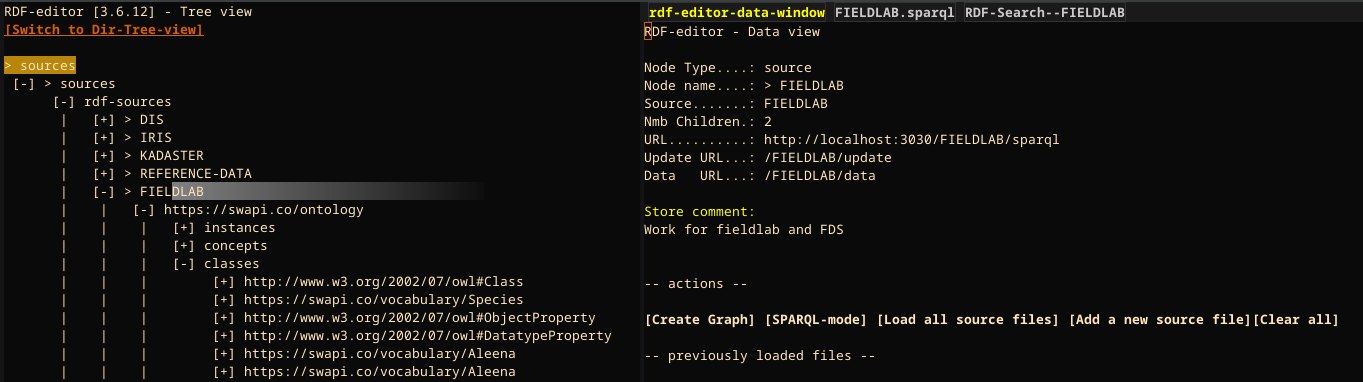
The ontology itself lives in the graph https://swapi.co/ontology.
The way to set rdf_fdw up to use this data is to first create a server, then to create a foreign table, and finally to query the foreign table2.
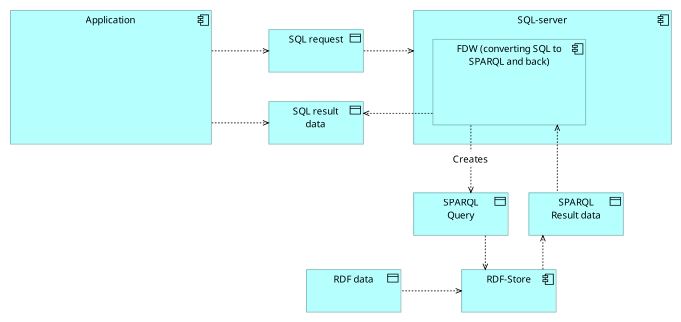
The resulting architecture is:
Creating the server
  CREATE SERVER swapi
  FOREIGN DATA WRAPPER rdf_fdw
  OPTIONS (endpoint 'http://localhost:3030/FIELDLAB/sparql');
Creating the foreign data table
CREATE FOREIGN TABLE swapi (
  klasse text OPTIONS (variable '?klasse',     nodetype 'iri'),
  label text  OPTIONS (variable '?label',     nodetype 'literal', literaltype 'xsd:string')
  )
SERVER swapi OPTIONS (
  sparql '
PREFIX rdfs: <http://www.w3.org/2000/01/rdf-schema#>
PREFIX rdf:  <http://www.w3.org/1999/02/22-rdf-syntax-ns#>
PREFIX owl:  <http://www.w3.org/2002/07/owl#>
Select ?klasse ?label FROM <https://swapi.co/ontology>
WHERE { BIND(!BOUND(?parent)  as ?check) FILTER (?check) FILTER (!isBlank(?klasse))
  { SELECT ?klasse ?instcount ?label ?parent
    WHERE { { SELECT ?klasse (count(?inst) as ?instcount)
      WHERE { ?inst rdf:type ?klasse. FILTER ISIRI(?klasse) }
      GROUP BY ?klasse } UNION { ?klasse rdf:type rdfs:Class }
      UNION { ?klasse rdf:type owl:Class }
      OPTIONAL { ?klasse rdfs:label ?label }
      OPTIONAL { ?klasse rdfs:subClassOf ?parent .
	FILTER ISIRI(?parent) } } } }
');
This is one the base queries that RDF-Editor uses to create the treeview,
Accessing the table using a query
Et voila:
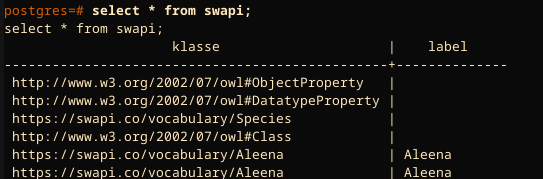
The result of the query to PostgreSQL, which was fetched in real time from the Fuseki data store. The important part here is that the SELECT on the RDF store can be as complex as needed. This allows for off-loading complex multi-join queries to the RDF store, which usually is much better at solving these kinds of queries.
Conclusion
rdf_fdw is a significant advancement. As many BI tools can only connect to relational data stores, the ability to now access RDF data via a relational interface is highly beneficial. Additionally, the absence of intermediate storage and data copying ensures that linked data solutions align better with the current paradigm of using data at the source, which is a popular paradigma in the Netherlands. Finally, its lightweight nature, being just a PostgreSQL extension, makes it a very attractive option.